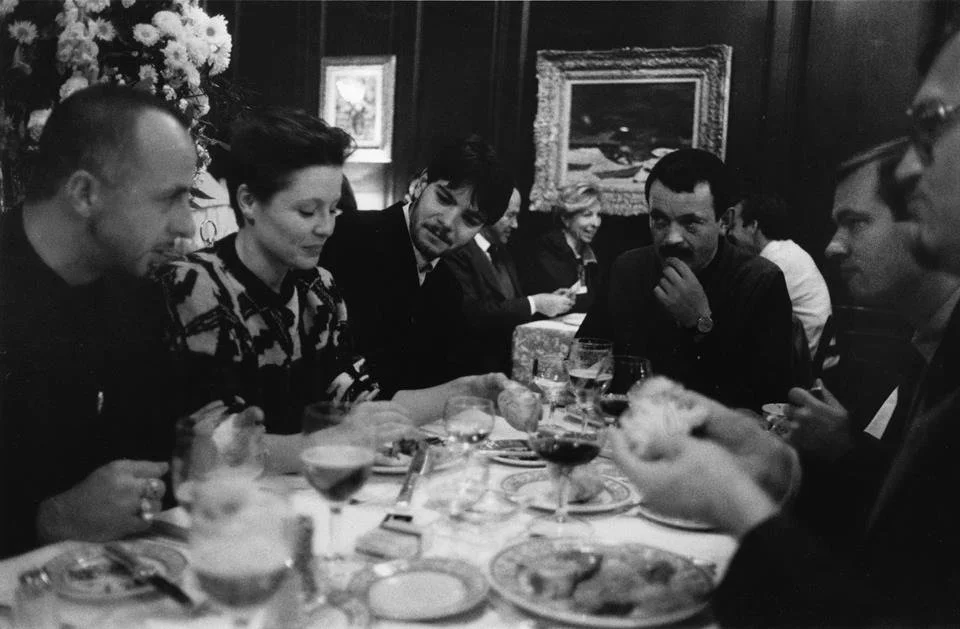
1983 at the Kronenhalle in Zurich with Jörg Immendorff, Ulrike Harbig, Bernd Koberling, Peer Kirkeby and Johannes Gachnang. Photo: Benjamin Katz
Hans Peter Riegel was born in Düsseldorf into a family deeply interested in the arts. He studied Visual Communication, Photography, Film, and Art Theory at the Düsseldorf University of Applied Sciences graduated with a Master of Arts (M.A.) and pursued partial studies in Philosophy at the University of Düsseldorf.
In 1973, through his art teacher Wilfrid Polke, the elder brother of Sigmar Polke, he met Joseph Beuys for the first time. At the age of thirteen, Riegel interviewed Beuys for a school magazine.
In 1975, Riegel met Beuys’s student Jörg Immendorff during a school-based political project. The two initially became close friends and later formed an intensive working partnership. Following an internship in stage design at the Düsseldorfer Schauspielhaus, Riegel worked as Immendorff’s assistant from 1979 to 1984 – a period also marked by numerous encounters with Beuys.
During these years, Riegel worked as a photographic and film documentarian for Immendorff and collaborated with him on various projects, actions and publications, including FF bringts, Café D. gut, Weltfrage – Video und Edition, 38., 39., 40. Parteitag and La Paloma – Kapelle am Wegesrand. He also coordinated Immendorff’s media relations, initiated and organised projects, created staged photographs, and designed posters and exhibition catalogues.
Riegel initially worked in painting but soon turned to photography, film, video and, later, digital media. His interest in applied design and contemporary media eventually led him into the advertising industry.
After completing his studies and spending an extended period in New York, Riegel began his professional career in 1984 as an art director and copywriter at the legendary agency GGK Düsseldorf. At the age of 24, he was the agency’s youngest art director.
In the following years, he worked for GGK in Paris, Zurich and Basel, as well as for Lowe/Lürzer and Brindfors. He later managed agencies within the international BBDO and Publicis networks as creative director, managing director and partner. His work received numerous awards, including distinctions from the Art Directors Club Germany and the Art Directors Club Switzerland, as well as Clio Awards. In 1985, he received the German Print Design Award in Gold and the Honorary Award of the Berlin Senate. He served as a jury member at the Cannes Lions International Advertising Festival and continues to serve as a juror for the Art Directors Club Switzerland.
Riegel has lived in Zurich since 1989. In 1992, he also established a residence in Düsseldorf and founded BRP – Bettzüge Riegel Partner together with advertising consultant Frank Bettzüge. Publicis acquired a majority stake in the company as early as 1993. Riegel subsequently joined the major agency Publicis/FBC in Hamburg as CEO and shareholder.
In 1992, he also played a key role in developing a “Powerhouse” concept for Apple, an early study for innovative brand experience spaces. This environment later gave rise to The Garden in Düsseldorf, a multimedia event centre conceived by Riegel that combined internet applications, live television, telecommunications, entertainment and physical interaction.
In 1997, Riegel withdrew from the traditional advertising industry. The Riverside AG, which he had already founded in Zurich in 1995, was initially conceived as a private investment company but increasingly focused on projects at the intersections of strategy, media, technology, entertainment and culture.
As a strategic consultant and business partner, Riegel developed pioneering projects in digital media and cultural production. From 1997 to 2000, he advised fashion entrepreneur Otto Kern on transforming his loss-making production company into a successful licensing business. He also provided strategic support for the initial public offering of Pixelpark, then a Bertelsmann investment and, at the time, Europe’s largest internet agency.
From 1998 until the end of 2001, Riegel served as CEO and partner of the EPM Media Group in Hamburg. The company operated in the fields of digital media, entertainment and cultural production. During this period, Riegel was responsible for numerous media and live productions. These included concerts by the Vienna Philharmonic in Vienna and Berlin in 1999, which were broadcast worldwide on television, as well as approximately 1,200 other productions featuring internationally renowned artists. Riegel left EPM Media AG at the end of 2001.
He subsequently refocused on Riverside and selected consulting mandates. Until 2010, he worked primarily for companies and individuals in the fashion, media, music and entertainment industries.
At the same time, he systematically resumed his own artistic practice. Under the pseudonym SIS.TM, he began developing a conceptual art project in 2002 that critically examined the internet and the emerging process of digital socialisation – particularly through video works, photography, digital images and texts. He was among the first artists worldwide to explore the internet simultaneously as a medium, a social space and a subject of artistic investigation. The project attracted considerable interest and was featured, among other broadcasts, in the main evening edition of Swiss national television’s news programme Tagesschau.
The poetic and essayistic texts created as part of SIS.TM were published under the title Flickering Subjects and reissued in 2018. In 2008, Riegel declared the project concluded.
He subsequently devoted himself increasingly to his work as an author, journalist and researcher in art history. He published articles and interviews on art, artists’ biographies and cultural policy in media outlets such as the Neue Zürcher Zeitung, Die Welt, Der Spiegel and Focus. His most important book publications include:
2010:Immendorff – Die Biographie, together with the illustrated documentary volume Inside Immendorff
2013: First edition of Beuys – Die Biographie
2018: Substantially expanded new edition of Beuys – Die Biographie
2018: Updated and expanded new edition of Immendorff – Die Biographie
2019:Über Kunst
2021: Expansion of the Beuys biography into four volumes
2026: Newly revised and updated four-volume edition of the Beuys biography
Now comprising approximately 1,500 pages, Riegel’s biography of Joseph Beuys has significantly changed the reception of the artist, attracted international attention and is today regarded as the standard German-language work on Beuys.
In 2016, Riegel made the essayistic documentary film Mel. Das andere Leben with a budget of approximately CHF 30,000. He was responsible for directing, screenwriting, cinematography, editing, sound design, music and production, among other roles. The film was released in cinemas in February 2017.
This was followed by the experimental feature film Drifted, which Riegel wrote and directed. He was also responsible for the cinematography, editing, visual design and parts of the music. Drifted was shot entirely on smartphones, making it one of the earliest European cinema productions to deliberately dispense with conventional film cameras.
In 2022, he also made the documentary film Beuys – Ein deutscher Künstler, which combined biographical research with a critical examination of the artist’s public persona.
Hans Peter Riegel has also been active in music since his youth. Under the pseudonym AZILE, he has produced music for commercials as well as electronic and experimental soundtracks.
In 2020, Riegel and his wife Tanja Hollenstein jointly founded the publishing house Riverside Publishing and Riverside Culture, a producer of ambitious cultural events.
That same year, they jointly founded DA Z – Digital Arts Zurich, an international festival for digital art and digital culture. As its artistic director and curator, Riegel developed exhibitions, audiovisual concerts, performances, talks, conferences, and virtual- and mixed-reality formats. The project ended in 2026 after five editions of the festival.
In 2020, Riegel also conceived and realised the international art and cultural project Window of the World in St. Moritz.
In 2022, he wrote the libretto for the experimental opera Disrupted Scenes and directed its performance on the main stage of Zurich Opera House. The production was produced by Riverside Culture. A further developed version was presented at Zurich’s Wasserkirche in 2023.
Riegel’s own photographic, conceptual and media artworks have been shown in numerous exhibitions and are represented in private and public collections. Since 2016, his works have been exhibited at galleries including Bildhalle in Zurich and Pavlov’s Dog in Berlin. He continues to work as a media artist.
Alongside his activities as an author, artist and curator, Hans Peter Riegel is an entrepreneur and strategic consultant. Tanja Hollenstein has been a co-owner of the Riverside Group since 2020. Together, they have developed the company into a consulting and media group that combines corporate strategy, communication, reputation, transformation, digital media production and cultural projects.
With the establishment of Riverside Strategy AG on 1 June 2025, the Group’s strategic consulting activities were consolidated within a dedicated operating company. In 2026, Digital Media AG was added as a further operating company. Riegel’s role within the Group focuses particularly on strategic and creative development.
Hans Peter Riegel is the founder and creative director of the Riverside Group, which he leads together with Tanja Hollenstein. The Group is regarded as one of Switzerland’s leading addresses for strategy and communications consulting and is also an ambitious producer of digital media and cultural projects.
At the heart of Riegel’s personal work is the promotion of dialogue between different social groups through socially relevant strategic concepts, cultural platforms and digital media.
Hans Peter Riegel is a Swiss citizen and lives and works in Zurich.